A command centre cannot command. It can make a handoff visible: this arrived, this person decides, this object must leave, this information should not be public, and this paper is finished. Without those verbs, a wall calendar becomes an attractive new place to lose things.
Follow one ordinary invitation from Monday to Sunday. Do not copy real names, addresses, school details or work information into a public worksheet. Use a blank card during the rehearsal and apply the household’s actual privacy, school, employer and data-handling rules.
The five-handoff relay
The invitation enters one agreed inbox, not the fridge, bag and chat at once.
An owner records yes/no/wait and the date the decision is due.
The decision creates a physical or digital next item: form, gift, payment, clothing or question.
The outgoing item meets the door, bag or device that takes it away.
Useful records move to controlled storage; routine paper is reused, recycled or discarded appropriately.
Monday: capture without multiplying copies
Observe how information enters: paper through the door, email, messaging app, school portal, conversation. The command centre does not need to reproduce every system. Choose a single visible prompt or capture point that tells the next owner where the authoritative information lives.
Give captured paper a strict limit. A shallow inbox reveals backlog; a deep basket makes archaeology. If an item contains sensitive information, skip the open inbox and move it to an appropriate controlled place immediately.
Tuesday: assign a decision and an owner
“We need to deal with this” is not an owner. Record one name or role privately, one next decision and one due moment in the system the household can sustain. For shared tasks, define the handoff: one person decides attendance, another arranges transport, a third needs only the final time.
| Information | Possible treatment | Question |
|---|---|---|
| General household reminder | Visible if everyone concerned agrees. | Does the wall need the detail, or only the prompt? |
| Child, school or care information | Minimise exposure; follow the relevant rules. | Who truly needs to see it? |
| Work, finance, health or identity data | Keep off an open shared wall. | What controlled system owns the record? |
| Outgoing object | Stage visibly only when exposure is acceptable. | Can it leave without revealing private context? |

Wednesday: stage the physical next action
An invitation may create a signed form, a present, an outfit, a payment or a question. The wall should point to the item’s next place, not attempt to hold the whole project. A slim outgoing tray can carry envelopes; a hook can hold a return bag; bulky sports gear needs a different physical zone.
This is where the command centre and the entryway drop zone meet but do not merge. The command centre coordinates information and ownership. The drop zone handles the physical arrival and departure of daily objects.
Thursday: cross the threshold
Rehearse leaving at the real busy time. Can the outgoing item join the correct bag or door route without narrowing the exit? Is the final time in the calendar people actually check? If the system depends on someone reading a wall while already late, move the alert earlier or to the authorised digital source.
Friday: remove completed information
A command centre needs an exit more than another pocket. Once the invitation has completed its job, remove the public prompt. Archive only records the household genuinely needs and is permitted to retain. Reuse blank sides where appropriate; recycle or dispose of paper according to local services and confidentiality needs.
Weekend: reset in five minutes
The five-minute handoff reset
Empty capture; assign every item or move it to the controlled source.
Confirm the next seven days, not the whole life plan.
Move outgoing objects to their departure point.
Remove completed, duplicate and expired prompts.
Close private material and clear the route.
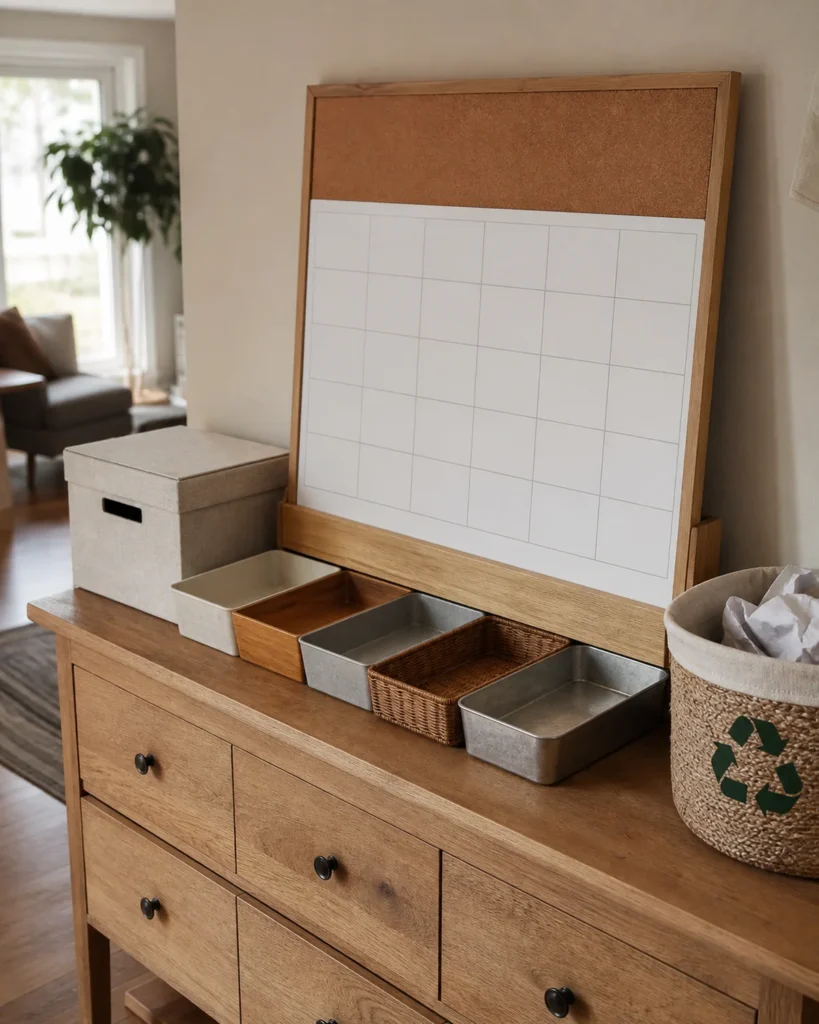
Choose the smallest format that completes the relay
Three honest formats
Good when the route, permission and mounting support it. Keep depth shallow.
A renter-friendly prototype that can test calendar, trays and privacy before attachment.
Useful when the authoritative information already lives in devices and the physical problem is departure.
Score the week, not the wall
- Every new item entered one capture path.
- Every unresolved item had an owner and next decision.
- Private detail stayed off the public surface.
- Outgoing objects met the correct departure route.
- Completed information left the system.
- The reset fitted the household’s realistic five minutes.
A missed appointment may have many causes; this article does not promise to prevent one. The useful verdict is narrower: did the system make the next handoff observable, and could the household reset it without one heroic organiser?
Build one week, then stop
Use a blank card to follow one real handoff before buying anything. Continue with the desk close-down guide for individual work papers, the first-apartment 24-hour route for a new household, and the organising-mistakes guide when objects lack homes and exits.
Sources and limits
What this guide can—and cannot—settle
These sources provide planning context, not property-specific approval. Product instructions, leases, local rules and qualified advice control where the work becomes structural, electrical, regulated or individual.
- NIST Privacy Framework — Vocabulary for identifying and managing privacy risk; no security guarantee.
- Federal Register: Safety Standard for Clothing Storage Units — Stability context where a covered freestanding storage unit is involved.
- U.S. Fire Administration: Home fire escape plans — Do not narrow or clutter an exit route.
- U.S. EPA: Reducing Waste—What You Can Do — Paper reduction, reuse and disposal context.
No products were tested and no personal household result is claimed. The room scenes are original editorial visual studies, not documentary evidence or compliance proof.