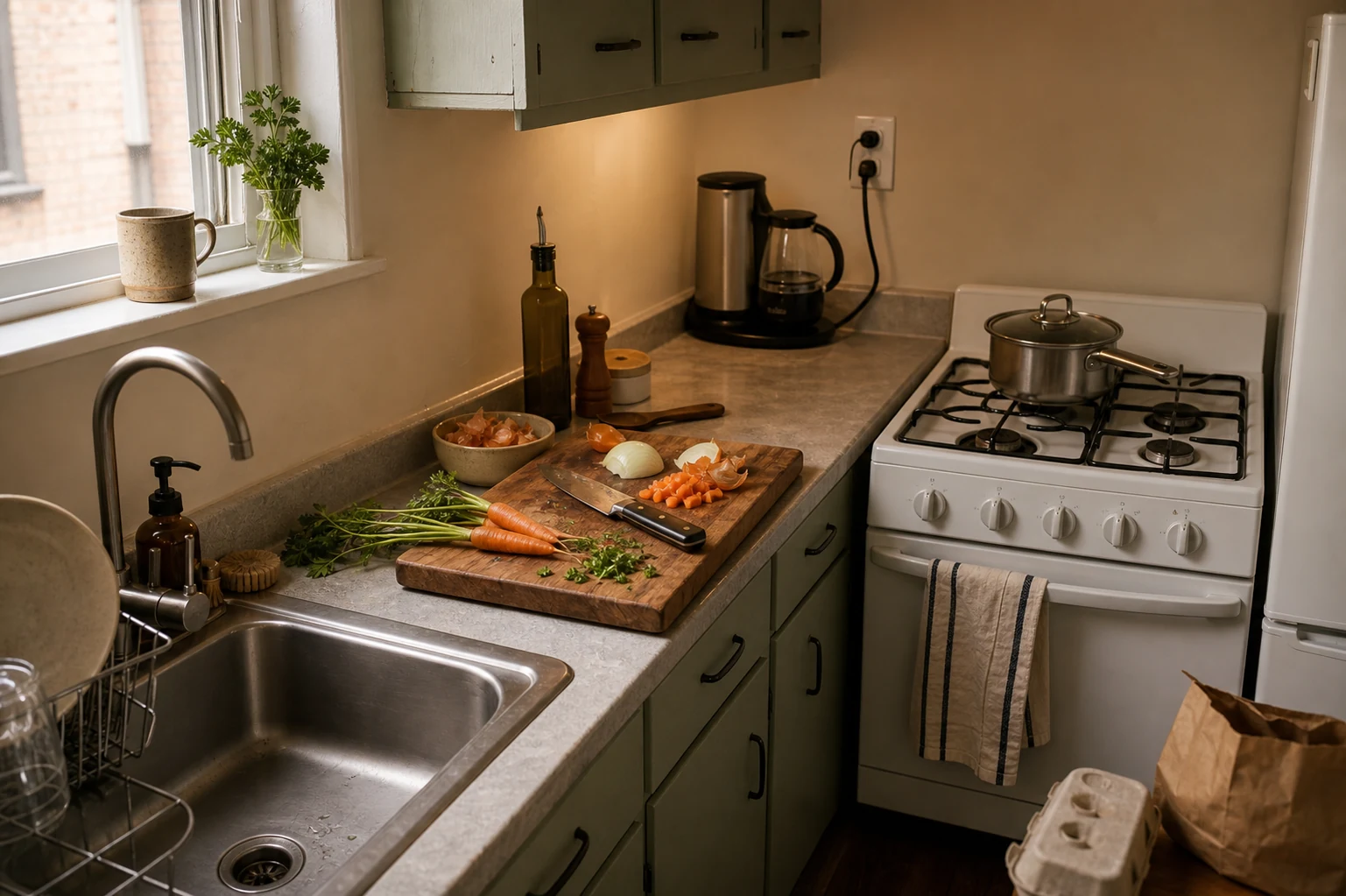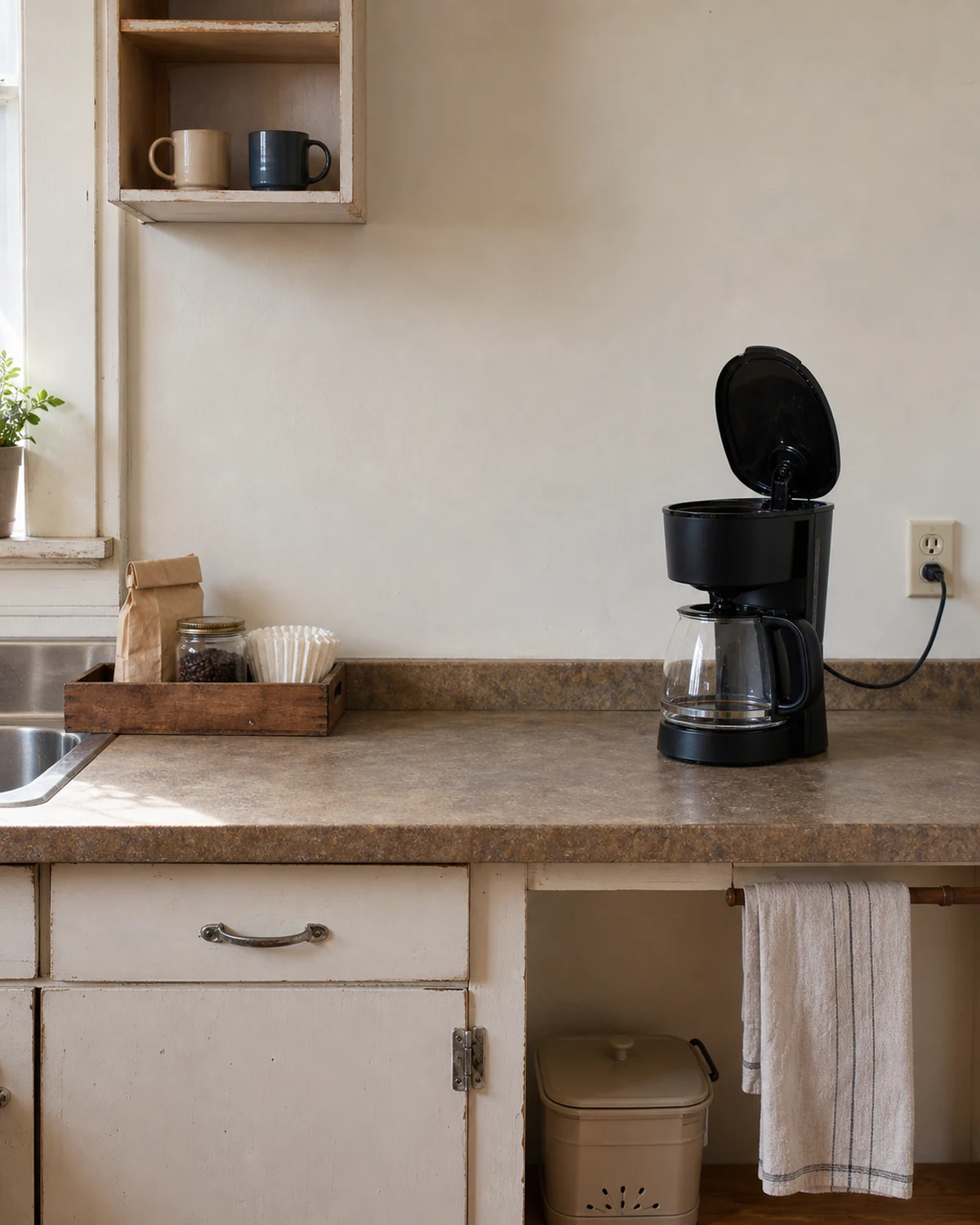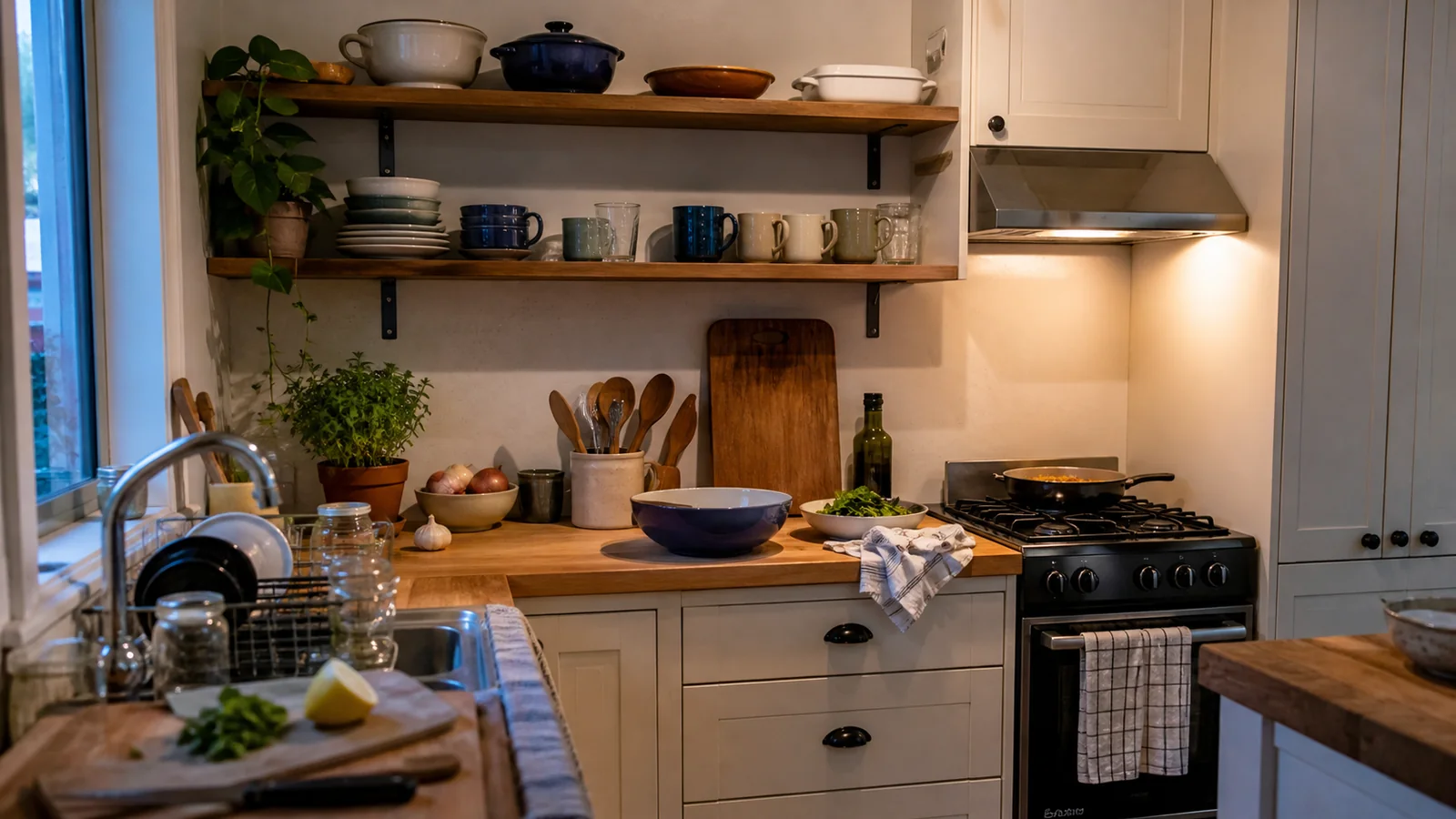
Open shelves are accused of gathering dust and praised for making kitchens feel light. Both statements are too lazy to arrange a single bowl. The shelf succeeds item by item: how often it is used, what reaches it, how it is washed, whether it can return, what heat and grease arrive, and where its replacement lands.
Do not remove cabinets or alter mounting to perform this audit. Start with an existing shelf, a temporary freestanding surface, or a drawn elevation. Structural support, fasteners and load limits belong to current product documentation, the wall and qualified local assessment.
| Question | Good open candidate | Move or close when… |
|---|---|---|
| Frequency | Used often enough to cycle through washing. | It waits untouched while collecting residue. |
| Care | Easy to lift, wash, dry and return. | Fragile stacks or complex cleaning make return unreliable. |
| Environment | Away from cooking spray, heat, moisture and cleaners. | The location creates contamination or damage concerns. |
| Information | Identity and instructions remain available where needed. | Decanting would discard dates, allergens, preparation or safety information. |
| Load | The exact shelf and support are used within instructions. | Weight, wall, fastener or movement is uncertain. |
Give each shelf a job
Draw an elevation. Mark the normal hand reach, the sink, the preparation area, hob or oven, kettle and any wall cabinet doors. The shelf nearest the working route should not automatically hold the prettiest ceramics; it should hold the robust objects that genuinely move through that route.
A three-band shelf elevation
Robust bowls, mugs or plates used and washed frequently. Leave a return gap.
Light, stable pieces that can be reached safely and do not interrupt daily return.
Heavy, fragile, greasy, sensitive, visually noisy or information-dependent items.
Connect use to washing capacity
A shelf of eight cups is only low-friction if the household can wash, dry and return them at the pace used. Watch one cycle. Does the dish rack hold the shelf’s daily group? Do tall stacks become unstable when only one bowl is clean? Is the return path blocked by a kettle or grocery landing zone?
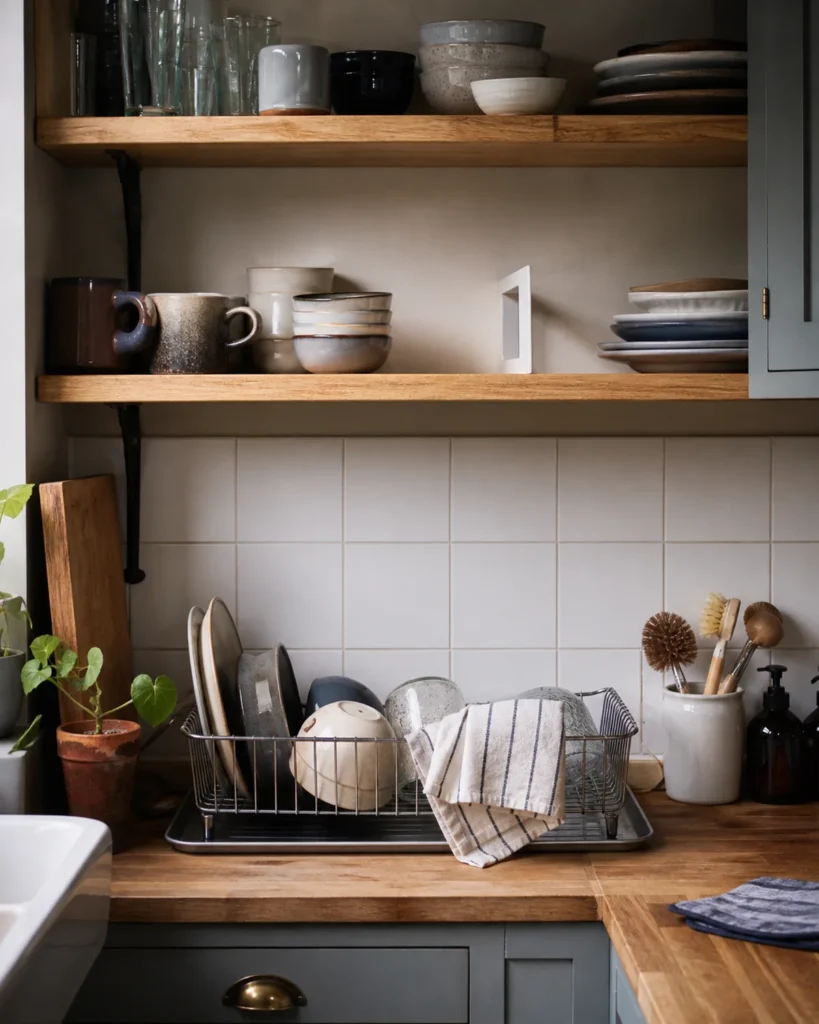
Draw the heat, grease and chemical exclusions
Use the cooking appliance’s instructions and current fire-prevention guidance. Do not invent a clearance from a blog photograph. Mark areas exposed to cooking spray, steam or heat, and keep cleaners separate from food and food-contact items. If an object needs frequent degreasing to remain display-worthy, the shelf may be asking it to do the wrong job.
Run the shelf for seven days
Monday to Sunday
Refill: where does the grocery bag land, and what overflows first?
Cook: which items are reached with wet, oily or busy hands?
Wash: can the drying rack return a full cycle to the shelf?
Share: can another user understand the shelf without a tour?
Reset: what needs wiping, decanting avoided, or moving behind a door?
Overflow: what happens when guests, baking or bulk food appear?
Verdict: keep open, move lower/higher, close, reduce or replace nothing.
Log a mark each time an item is used, washed, returned, refilled, wiped around or moved to reach something else. The log is not a moral score. A serving bowl can deserve an open place because it gives the room joy, provided the maintenance and footprint are understood. The purpose is to distinguish chosen display from accidental exposure.
Use closed storage without apologising
Closed cabinets handle visual noise, occasional equipment, sensitive food information and awkward packaging brilliantly. Open shelves make robust daily objects visible and reachable. A mixed system lets each do what it does well. The brave edit may be leaving half a shelf empty so tomorrow’s clean dishes have somewhere to return.
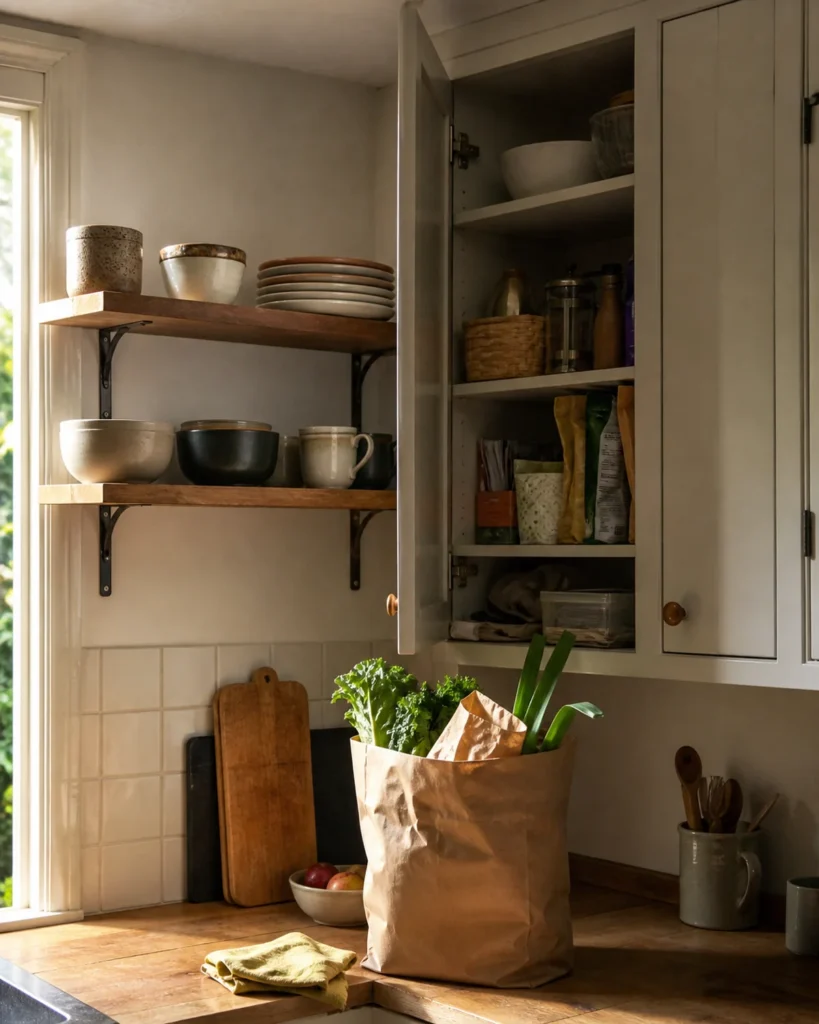
Sunday verdict: five possible decisions
Frequent, careable, stable and easy to return.
Right object, wrong height or exposure.
Protected or quieter storage suits it better.
The stack exceeds the real wash/return loop.
The system needs space, not matching containers.
Style what survives
After the audit, repeat one colour or material already present, vary heights only where retrieval remains safe, and leave the return gap visible. Continue with the whole-kitchen cooking workflow, the pantry food-flow guide, and the coffee-station refill loop. For the retrieval-first styling analogy outside kitchens, open the usable bookshelf guide.
Sources and limits
What this guide can—and cannot—settle
These sources provide planning context, not property-specific approval. Product instructions, leases, local rules and qualified advice control where the work becomes structural, electrical, regulated or individual.
- U.S. FDA: Are You Storing Food Safely? — Food-storage principles; original labels and current food guidance control.
- U.S. Fire Administration: Cooking fire prevention — Cooking-zone fire prevention context; appliance and local requirements control.
- U.S. Access Board: Clear Floor or Ground Space and Turning Space — Reach and clear-space concepts used as context, not compliance proof.
- U.S. EPA: Reducing Waste—What You Can Do — Reuse and waste-reduction context before buying container systems.
No products were tested and no personal household result is claimed. The room scenes are original editorial visual studies, not documentary evidence or compliance proof.